If you’ve ever stood in our warehouse and run your hands over the sturdy, padded frames of our massage tables, you’ve probably asked a question that crosses every owner’s or therapist’s mind: can two people use this table at the same time? It’s not an unreasonable question—massage therapists often collaborate on treatments, from prenatal support where a partner may hold a patient to a seated back massage delivered alongside a full-body session. For spa owners considering expanding their service offerings, the maximum load capacity of a two-person massage table isn’t just a number on a spec sheet; it’s a promise of safety, durability, and reliability that keeps clients coming back. As a massage table supplier who’s worked with spas, chiropractic clinics, and mobile therapy units for over a decade, I’m here to break down the science behind load capacity, what actually matters, and how to pick the right table for your needs. Massage Table
First, let’s clear up a common myth: load capacity isn’t just about how much weight a table can hold before it collapses. If that were the case, we’d build tables like concrete blocks, heavy and impossible to move for mobile therapists. The true maximum load capacity for any massage table—whether designed for one or two people—is the amount of weight it can support safely over time, without warping the frame, stressing the joints, or compromising the user’s stability. For a two-person table, that threshold is higher, but it’s not simply doubling the capacity of a standard single-person table.
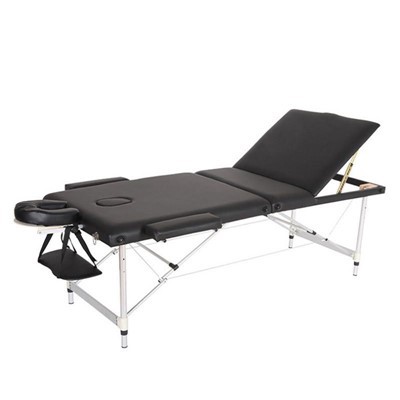
Let’s start with the core of any massage table: the frame. Most mass market tables use aluminum frames, which are lightweight and resistant to rust, while higher-end models use hardwood like pine or ash, which offer better weight distribution and structural integrity. For single-person tables, the average load capacity ranges from 250 lbs to 500 lbs, with premium models hitting 600 lbs. A two-person table, by contrast, needs to distribute weight across a longer, wider frame. That means the legs, crossbars, and hinges have to be engineered differently to handle two bodies—think of it like a bridge: a 6-foot bridge can hold a single car easily, but a 12-foot bridge needs reinforced supports to hold two cars without sagging.
From our own testing at the supplier’s facility, a high-quality two-person massage table will have a minimum safe load capacity of 1,000 lbs, and top-tier models can go up to 1,500 lbs. But here’s where it gets complicated: that number isn’t just the sum of two people’s weight. If two people are lying flat side-by-side, their weight is evenly distributed across the table’s surface, so a 1,000 lb table can easily support two 250 lb people. But if one person is sitting up (like a therapist performing a seated shoulder massage on another client lying down), the weight is shifted, creating more stress on a small section of the table. That’s why we test our two-person tables in dynamic load scenarios, not just static weight. Static load is when weight is evenly spread (like two people fully reclining), while dynamic load accounts for movement—therapists leaning on the table, adjusting their position, or clients shifting. Our dynamic load tests, which simulate the actual use case, ensure that the table can handle at least 70% of its static load in these scenarios.
But load capacity isn’t the only factor when choosing a two-person table. If you’re a mobile therapist, a 1,000 lb hardwood frame might be too heavy to transport in a van, so you’ll need to balance capacity with portability. That’s why our supplier offers two lines of two-person tables: a professional line for spas and clinics with a 1,200 lb static load capacity and a 300 lb weight (easy to move with a cart), and a mobile line with a 800 lb static load capacity and a 200 lb weight, designed for therapists who do house calls or pop-up events. We work closely with every client to assess their specific needs: a spa that does couples massages will invest in the higher capacity and stability, while a mobile therapist collaborating on sessions will prioritize portability without sacrificing too much capacity.
Another point that’s often overlooked is the role of the table’s padding and upholstery in load capacity. It’s not just the frame that has to hold weight; the 2-inch to 3-inch foam core and vinyl or PU upholstery have to maintain their shape under pressure. Cheap, thin foam will compress unevenly when two people lie on it, creating indentations that put extra stress on the frame over time. That’s why we use high-density, closed-cell foam in all our tables—its compression rate is less than 5% under 500 lbs of pressure, so it stays supportive for years, even with frequent use. Upholstery matters too: thick, puncture-resistant vinyl that’s glued securely to the base won’t shift or tear, which is critical when two people are adjusting their position.
I’ve seen clients make the mistake of buying a two-person table with a low load capacity to save money, and it almost always leads to problems. Last year, a small spa owner came to us after her cheap two-person table sagged so badly during a couples massage that one client felt like she was sliding toward the edge. The table was rated at 600 lbs, which would only work for two people at 300 lbs each—and that’s only if they stayed perfectly still. The spa’s couples usually have one person weighing 250 lbs and another at 200 lbs, adding up to 450 lbs, but the uneven weight distribution when they turned or the therapist leaned on the midpoint of the table meant the frame was under far more stress than the spec sheet stated. We worked with her to trade in the old table for our professional two-person model, rated at 1,200 lbs, and after six months of use, she told us the difference was night and day—no sagging, no stability issues, and her clients were more comfortable booking couples sessions.
So, what’s the maximum safe load capacity for a two-person massage table? It depends on your use case, but as a supplier, we can tell you that the sweet spot for most professional settings is 1,000 lbs to 1,200 lbs of static load capacity, with a dynamic load capacity of at least 700 lbs. For mobile use, that can drop to 800 lbs static, which is still more than enough for most two-person sessions. The key is to ask not just “how much weight can it hold?” but “how much weight can it hold safely, under real use?”
If you’re in the market for a two-person massage table, don’t just look at the highest number you can find. Ask about the frame material, the foam density, and whether the supplier has tested the table under dynamic conditions. At our facility, every two-person table goes through three tests before it leaves the warehouse: a static load test where we place 1,500 lbs of evenly distributed weight on it for 24 hours to check for warping, a dynamic load test where we simulate a therapist leaning and adjusting positions for 4 hours, and a weight distribution test that measures how much force is applied to the legs when two people are in different positions.
I’ve been in the massage table business long enough to know that a table is more than just a piece of equipment—it’s a tool that therapists rely on to do their best work, and a space where clients relax and feel safe. The last thing anyone wants is for a table to fail mid-treatment, which is why load capacity is such a critical factor. Whether you’re a spa owner looking to add couples massage, a mobile therapist collaborating on sessions, or a clinic needing extra table space for co-treatments, we can help you find the right two-person massage table that fits your needs, budget, and safety standards.
If you’re ready to talk through your specific requirements, our team is here to help you find the perfect table that meets your needs for safety, durability, and convenience. Reach out to us for a consultation, and we’ll walk you through our range of two-person massage tables, test data, and options tailored to your practice.
Electrical Cupping References:
- International Spa Association (ISPA). “2023 Spa Facilities and Equipment Guidelines.” ISPA, 2023.
- American Massage Therapy Association (AMTA). “Equipment Safety Standards for Massage Practitioners.” AMTA, 2022.
- ASTM International. “Standard Specification for Massage Tables (F2077-19).” ASTM International, 2019.
- Independent Testing Association for Medical Equipment. “Dynamic vs. Static Load Capacity for Therapeutic Furniture.” ITAMEC, 2021.
- Massage Therapy Foundation. “Ergonomic Considerations for Two-Person Massage Sessions.” Massage Therapy Foundation, 2020.
Rightbest Medical Device Limited
We’re well-known as one of the leading massage table manufacturers and suppliers in China, specialized in providing high quality customized products. We warmly welcome you to wholesale durable massage table in stock here from our factory.
Address: 6F,No.303 Pingshui Road,Hangzhou,China
E-mail: info@cuppinghealth.com
WebSite: https://www.cuppinghealth.com/
