Hey everyone, and welcome to the blog. If you’re running a grain drying operation, or you’re someone who’s been tasked with setting up a new grain dryer system, you’ve probably asked yourself at least once: “How much space do I actually need between all these supporting pieces?” Trust me, I get it. When you’re dealing with grain dryers, surge bins, fans, heaters, conveyors, and all the other little parts that make the whole thing run, it’s easy to just start slapping equipment together to save floor space. But let me tell you—cutting corners here almost always leads to bigger headaches down the line. I’ve been in the grain dryer supporting equipment game for over a decade now, and I’ve seen first-hand what happens when someone doesn’t get these distances right. So today, I’m breaking down exactly what’s recommended between each key piece, no confusing jargon, just real talk. Grain Dryer Supporting Equipment

First off, let’s get one thing straight: there’s no one-size-fits-all number here. A lot of people try to give you a single “standard” distance, but that’s garbage. It depends on so many factors—like the size of your dryer, the type of grain you’re drying, whether you’re working with overhead doors, how much maintenance you need to do, and even how tall your ceiling is. That said, there are solid baseline recommendations from industry experts that work for most setups, and I’m gonna lay those out. Also, keep in mind that these are the minimums. If you can squeeze a little more space in, do it. You’ll thank me later when you’re not stuck trying to fish a broken belt out of a tight gap at 2 a.m. during harvest.
Let’s start with the workhorse of most grain systems: the grain dryer itself. That big bad boy is the center of your whole operation, right? So what’s around it? First, you’ve got the side access panels. Most commercial grain dryers have those big metal doors on the sides where you load and unload grain, and where the internal augers or drying lanes are serviced. The minimum distance from the side of the dryer to the nearest wall or any other piece of equipment needs to be at least 3 feet. Wait, 3 feet? That’s it? Yeah, but that’s the absolute bare minimum. If you can swing it to 4 or even 5 feet, do it. Why? Because when you’re pulling a grain bin full of wet grain up to the dryer, you need space to maneuver the grain cart or the conveyor that’s feeding the dryer. Also, when you need to replace a small part inside the dryer—like a broken flight on the unloading auger—you don’t want to be stuck wedged against a wall, holding a wrench, and fighting the dryer at the same time. I had a customer a couple years back who cut this distance to 2.5 feet to save space, and he ended up having to pay three guys to yank a stuck auger out because he couldn’t get his arm in there. Cost him way more than the space he saved.
Now, what about the front of the dryer? That’s where the control panel is, right? And usually the air intake or exhaust stack is there too. The control panel needs to be easily accessible for operators to adjust temperature, check moisture levels, and shut the whole thing down in an emergency. So the minimum distance here is 4 feet. That makes sense—you need room to walk up, bend down, and reach all the buttons without bumping into anything. If your dryer has an exhaust stack that goes up, you also need to make sure there’s no other equipment directly in front that could block airflow. Exhaust backpressure is a huge problem—if the air can’t get out of the dryer properly, it dries unevenly, wastes fuel, and can even cause overheating if you’re not careful. So leaving that 4 feet in front isn’t just for convenience; it’s for the performance and safety of your whole system.
Next up, the surge bin. Most dryers don’t feed directly from a grain cart—you’ve got a surge bin between the incoming grain and the dryer, right? It holds a batch of wet grain so the dryer doesn’t have to stop every time you switch out a grain cart. So where does that go relative to the dryer? The most common setup is the surge bin is directly above the dryer’s feed point, or right next to it. If it’s right next to the dryer, what’s the space between them? Let’s think about the conveyor that connects the surge bin to the dryer. That conveyor—usually a screw conveyor or a belt conveyor—needs to be installed at a slight angle to keep grain moving smoothly, and it needs to be accessible for maintenance. The minimum distance between the side of the surge bin and the side of the dryer is 2 feet? Wait, no, hold on. If you’re talking about the gap where the conveyor runs, it’s not just two feet. I’ve seen guys put surge bins and dryers almost touching, but that’s a bad idea. You need at least 3 feet of space between the surge bin and the dryer to fit that conveyor, plus enough room to inspect the connection point, clean out any spilled grain that gets stuck, and replace the conveyor’s hanger bearings when they go bad. If you have to pull the whole surge bin just to change a bearing, that’s hours of downtime during harvest. Pro tip: if you can swing 4 feet here, you can use a longer conveyor that’s less prone to jamming, and you’ll have way more flexibility if you ever need to upgrade either the surge bin or the dryer down the line.
Now, the big fans and heaters. The air moving through your dryer—you’ve got centrifugal fans that blow ambient air or heated air through the grain column, and that fan is usually connected directly to the dryer’s plenum. Wait, but where does that fan unit go relative to the dryer? If it’s a high-capacity fan, it’s not just a little box. It’s a big, heavy piece that makes noise, vibrates, and needs its own access for maintenance. The minimum distance between the fan and the dryer’s air inlet is usually the length of the ducting between them, but you also need space around the fan itself. The fan should be at least 3 feet away from any walls or other equipment because of vibration. If you mount a fan too close to a wall, the vibration can loosen the duct connections over time, which leads to air leaks. Leaky air means you’re wasting fuel, because the heated air is escaping before it even gets to the grain. Also, fans need to be able to pull air in properly—if there’s a wall or another equipment blocking the intake side, you’ll get less airflow, which slows down drying time. So leave 2 to 3 feet around the entire fan unit, not just next to the dryer. And don’t forget about the heater if you’re using a heated air system—propane or natural gas heaters need clearance for their exhaust vents too, usually at least 1 foot from combustible materials, but I always recommend 2 feet to be safe.
What about conveyors that run along the floor, like the main grain conveyor that takes dry grain from the dryer to a storage bin? That’s usually a screw conveyor running parallel to the dryer or to a row of dryers, right? How much space do you need between that floor conveyor and the dryer? You need at least 2.5 feet of clearance from the floor conveyor to the side of the dryer, and also enough space above the conveyor for service. Wait, floor conveyors are low to the ground, so if you step over them, you need to make sure there’s no obstacle right next to them. Also, when you’re hooking up the unload auger from the dryer to the floor conveyor, you need a little flex in that connection to account for vibration. If the conveyor is too close, it’s hard to align the auger, and you’ll get grain spilling out of the connection, which is a fire hazard (spilled grain builds up dust, and dust ignites super easy) and a waste of product. I’ve had customers who tried to cram two conveyors and a dryer into a 10-foot bay, and they ended up with grain piling up on the floor, which they had to sweep out every single day during harvest. Don’t do that—leave at least 3 feet between the dryer and any floor-mounted conveyors.
Now, what about overhead clearance? A lot of people forget this one, because they’re focused on floor space. If you’ve got overhead conveyors, or if you’re lifting grain with a crane or a hoist to service the dryer, you need way more space than you think. The minimum overhead clearance above the top of the dryer is 8 feet, but if you’re lifting heavy parts like augers or fan blades, you need at least 10 feet. If your ceiling is only 9 feet tall, you might have to install a freestanding lifting beam instead of using the ceiling structure, which is doable, but it’s something you need to plan for before you pour the floor. Also, if you have ductwork running from the heater to the dryer overhead, that takes up space too, so add 1 foot of clearance above any overhead equipment to avoid rubbing and damaging the ducts.
Wait, let’s talk about a common mistake I see all the time: grouping all the supporting equipment too tight for a single dryer, or even putting two dryers too close together. If you have two grain dryers, how much space between them? The same rules apply as a dryer and a wall, right? But if you need to run maintenance between two dryers, you need at least 5 feet between them. I’ve seen two dryers 3 feet apart, and when one breaks down, you can’t even get a tool between them to fix the other. During harvest, you can’t afford to have one dryer down, let alone two. If you have multiple dryers, spacing them 6 to 8 feet apart gives you room to work on both, and also lets you route separate air intake and exhaust stacks so they don’t cross-contaminate each other’s airflow. Cross-contamination is a big deal—if exhaust from one dryer is sucked into the intake of another, it can mess with the temperature and moisture levels of the grain in the second dryer, leading to uneven drying.
Also, don’t forget about safety zones. OSHA (Occupational Safety and Health Administration) has specific guidelines for grain handling equipment, and those clearances I mentioned? They’re not just random numbers—most of them line up with OSHA’s safety recommendations. For example, all moving parts (augers, fans, conveyors) need to have at least 1 foot of clearance from walkways, so no one accidentally bumps into a spinning auger. And all access points for maintenance need to be unobstructed, so you can get in and grab someone if there’s an emergency. I can’t tell you how many times I’ve heard stories of a guy getting his arm stuck in an auger because he couldn’t get it loose from a wall that was too close, and by the time someone could get to him, it was too late. That’s why those clearances matter—they’re not just about convenience, they’re about keeping people safe.
Wait, what if you’re working with a small farm, not a big commercial operation? Like, you have a 5,000-bushel dryer, not a 50,000-bushel one. Do the distances change? A little, but not by much. For small dryers, the side access clearance can drop to 2.5 feet, the front access to 3.5 feet, and the space between a small surge bin and dryer to 2 feet. But even for small setups, I still recommend upping those numbers by 0.5 feet if you can. I had a small farmer client a few years back with a 3,000-bushel dryer who cut side clearance to 2 feet, and during a busy harvest, his unloading auger seized up. He spent 4 hours trying to yank it out, and ended up losing half his grain batch because it sat in the dryer too long. That 6 extra inches would’ve saved him a ton of time and money.
Another thing: always account for future upgrades. If you think you might expand your dryer system in 5 years, leave extra space now. Don’t build your bays exactly to fit the equipment you have today, because 5 years from now, you might want a bigger dryer, or an extra surge bin, or a second conveyor. I’ve seen so many guys pour a concrete pad that’s perfect for their current system, then have to jackhammer part of it because they couldn’t add new equipment without rearranging everything. That’s a huge waste of money. Adding 1 or 2 extra feet of clearance everywhere pays for itself when you don’t have to do that.
Now, let’s run through a quick recap, just to make sure it’s easy to remember:
- Dryer side access: Minimum 3 ft, ideal 4-5 ft
- Dryer front access (control panel/exhaust): Minimum 4 ft
- Surge bin to dryer gap: Minimum 3 ft, ideal 4 ft
- Fan/heater clearance: Minimum 2-3 ft around all sides
- Floor conveyor to dryer: Minimum 2.5 ft, ideal 3 ft
- Overhead clearance above dryer: Minimum 8 ft, ideal 10 ft
- Between two dryers: Minimum 5 ft, ideal 6-8 ft
Like I said at the start, these are baseline numbers. Every setup is different, so make sure you check your equipment’s specific manual—your dryer, your surge bin, your fan might have their own manufacturer recommendations that override these. But these are the numbers that work for 90% of the systems I’ve installed or helped troubleshoot over the years.
At the end of the day, the goal is to balance space, cost, and functionality. You don’t need a huge warehouse full of empty space to run a good grain drying operation, but cramming equipment together just to save a few square feet is never worth it. I’ve worked with farmers who spent thousands on extra clearances and never regretted it, and I’ve worked with ones who tried to cut corners and ended up losing way more than that in downtime, repairs, or safety issues.
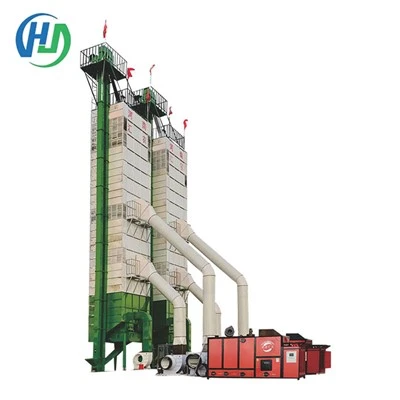
If you’re in the process of setting up a new grain dryer system, or you’re looking to upgrade your existing one, and you’re not sure exactly what clearances you need for your specific equipment, don’t guess. Reach out to us—we’ve got a team of experts who can walk you through the recommended distances, tailor them to your setup, and make sure you don’t end up with a mess during harvest. We’ve helped hundreds of farmers and operations get their systems right, so you can focus on what matters: drying grain and getting it to market.
Wheat Processing Equipment References:
- National Grain and Feed Association (NGFA). Grain Drying and Handling Equipment Installation Standards, 2021
- Occupational Safety and Health Administration (OSHA). Grain Handling Safety Guidelines, 2022
- ASABE Standard S411. Installation, Maintenance, and Operation of Grain Drying Systems, 2020
Henan Huinong Machinery Co., Ltd.
Henan Huinong Machinery Co., Ltd. is one of the most professional grain dryer supporting equipment manufacturers and suppliers in China, featured by quality products and low price. Please rest assured to buy discount grain dryer supporting equipment from our factory. We also accept customized orders.
Address: No. 6, Northeast Corner of the Intersection of Renmin Road and Zhujiang Road, New District, Huaxian County, Henan Province
E-mail: frank.tang@huinongmachinery.com
WebSite: https://www.huinongmachinery.com/
